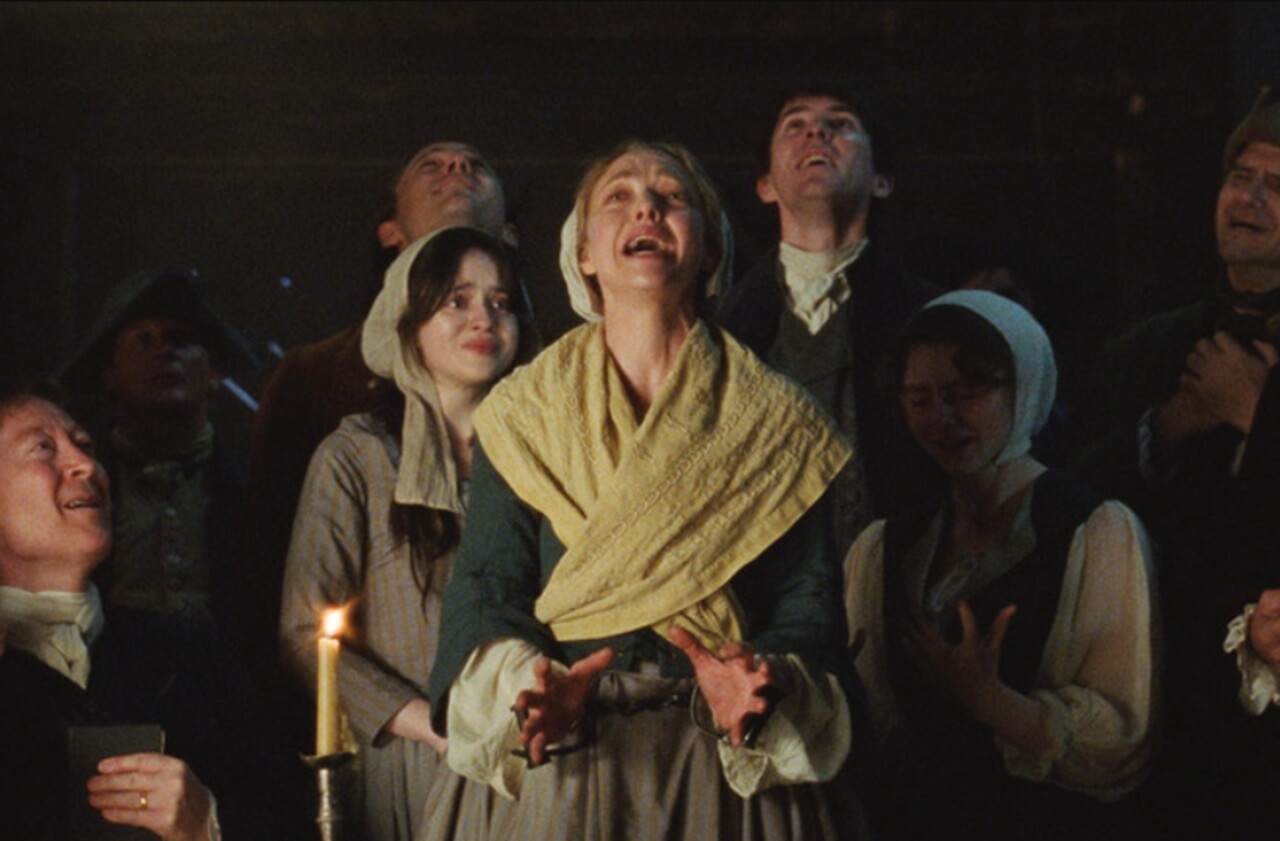
At first glance, The Testament of Ann Lee feels unlike any traditional movie musical. Songs erupt without warning, choreography resembles religious trance more than performance, and music feels inseparable from emotion. That is by design—and, according to the filmmakers, firmly grounded in historical fact.
Directed by Mona Fastvold and starring Amanda Seyfried, the film tells the story of Ann Lee, the 18th-century religious leader credited with founding the Shaker movement in America. As Fastvold and her collaborators have emphasized, the movie’s striking musical sequences are not modern inventions but reinterpretations of authentic Shaker worship practices.
Real Shaker hymns inspired the music
Composer Daniel Blumberg, who previously won an Oscar for his work on The Brutalist, drew heavily from historical Shaker material. In interviews, Blumberg said he was fascinated by early Shaker worship, particularly their use of wordless hymns and ecstatic vocalizations.
These hymns, often sung collectively and without structured lyrics, were a hallmark of Shaker religious expression. Fastvold researched these traditions firsthand, visiting libraries in Massachusetts and the Hancock Shaker Village museum, where she and Blumberg studied preserved sheet music and written accounts of Shaker songs.
While the melodies themselves often trace directly back to history, Blumberg reshaped them for the screen. Subtle key changes, counter-harmonies, and unconventional arrangements transform the hymns into something both ancient and unsettlingly modern.
Why Fastvold resisted calling it a “musical”
Despite the film’s heavy reliance on music, Fastvold initially hesitated to label The Testament of Ann Lee a musical. She described it instead as a “music and movement piece,” reflecting how Shakers used song and dance not for entertainment, but as acts of worship.
It was Fastvold’s longtime collaborator and partner, director Brady Corbet, who ultimately convinced her to embrace the term. With music woven deeply into the narrative, the distinction became unavoidable—even if the result defies musical conventions.
A different kind of performance
One major difference between this film and traditional musicals is intention. Shaker songs were expressions of spiritual release, not storytelling devices. As a result, the film integrates sound design directly into the music, blurring the line between singing, breathing, crying, and chanting.
This approach required Seyfried to fundamentally rethink her performance style. Though classically trained, she had to “unlearn” technical precision and instead allow sound to emerge instinctively. Fastvold has described rehearsal sessions that involved physical exhaustion, emotional vulnerability, and experimentation to find Ann Lee’s voice.
Ann Lee as a historical figure
Ann Lee was a real woman who emigrated from England to the American colonies in the 18th century. Her followers believed she embodied the second coming of Christ, and her teachings emphasized communal living, celibacy, labor as worship, and ecstatic expression through movement. Fastvold has said she was drawn to how Lee transformed personal trauma into compassion and community. That emotional truth, she believed, mattered more than strict biography—and Seyfried channels it with remarkable intensity.
A musical grounded in belief
By anchoring its musical numbers in authentic Shaker practice, The Testament of Ann Lee becomes less a spectacle and more a spiritual experience. The film doesn’t ask viewers to watch people sing; it asks them to feel why they sang. Opening in theaters on Christmas Day, the film stands as one of 2025’s boldest historical dramas—proving that sometimes the most radical cinematic choices are also the most faithful to history.